The UK defence minister’s shock resignation is a warning for all of Europe
Paul Taylor – The Guardian:
John Healey is right about the risk of wars. But it has become politically treacherous for Nato leaders to borrow for defence
Since the historic Nato summit in The Hague one year ago this month, European leaders have pledged massive increases in defence spending in the face of increasingly acute threats of Russian aggression. Yet the reality is that key west European governments – especially the UK, France and Italy – are not putting their money where their mouth is for fear of undermining lenders’ confidence in their national debt.
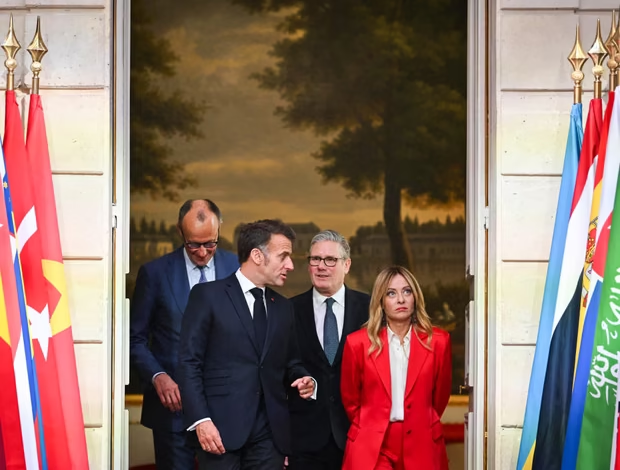
Keir Starmer, Emmanuel Macron and Giorgia Meloni are behaving as if they were more scared of the bond markets than they are of the Russians. The dramatic resignation of the UK defence secretary John Healey in protest over Starmer’s reluctance to ramp up investment highlights how politically treacherous it has become to find these much-needed resources.
In a damning resignation letter, the previously ultra-loyal Healey wrote to Starmer: “You have been unable, and the Treasury has
been unwilling, to commit the resources that the nation needs to defend the country at this time of rising threats.” He also pointed to the growing gap between the UK’s ambition as co-leader of the coalition of the willing – to provide security guarantees for Ukraine and restore freedom of navigation in the strait of Hormuz – and the funding the government is willing to provide.
The UK prime minister himself set out in stark terms the risk of more wars in Europe, saying on a visit to a drone manufacturer this month: “It is our intelligence assessment and the assessment of other countries in Nato that there could be an attack by Russia on Nato as soon as 2030.” Moscow is already conducting a covert war of sabotage, assassinations, cyber-attacks, drone intrusions and disinformation against Europe, and has switched to a war economy, spending an estimated 8% of its gross domestic product on the military.
A reluctance to increase national debt for defence is understandable at a time of economic uncertainty, when government borrowing costs have risen across the western world. But it risks leaving Europe’s hollowed-out armed forces dangerously exposed as the US under Donald Trump disengages from European security.
There is a possible way out of this dilemma, which is to borrow jointly for defence with willing European Nato allies, creating a
euro-denominated safe asset – something the financial markets have been seeking ever since the eurozone debt crisis began in 2010. The idea of eurobonds remains politically taboo in Germany, but Berlin did agree to one-off joint borrowing to support the EU economy during the Covid-19 pandemic. Defence bonds will have to be another exceptional measure justified by the exceptional geopolitical emergency. We can’t afford to wait until Russia actually attacks a Baltic Nato ally.
The European Commission granted EU countries extra leeway to borrow last year as part of a package of measures intended to turbocharge defence spending. Member states were allowed to borrow an additional 1.5% of GDP for military expenditure above the EU’s usual 3% budget deficit limit without incurring disciplinary action by Brussels. But EU economics commissioner Valdis Dombrovskis acknowledged last week that most countries are not making full use of this opportunity, which was supposed to generate an extra €650bn for defence spending across the continent.
Some allies are indeed rapidly increasing military expenditure – especially Germany, Poland and the Baltic states – because they had low debt-to-GDP ratios and can afford to borrow. Nato countries agreed at The Hague summit to boost defence spending to 5% of GDP by 2035. Of that, 3.5% is intended for core military outlays and the other 1.5% for related costs such as road, rail, bridge, port and airport infrastructure; for easing the rapid transit of troops and equipment; and for protecting energy and communications networks.
Germany plans to fulfil its 3.5% core defence spending goal by 2029, but the UK has only pledged to reach 3% some time in the next parliament – ie after 2029. Healey said the UK’s proposed trajectory would only take it to 2.68% in 2030, while those of France and Italy would only see them hit 2.5% by the end of the decade. The UK defence investment plan is six months late, leaving industry and international partners in limbo amid fierce guns-versus-butter fights in the cabinet over how to pay for it. These rows have now exploded into the open with Healey’s resignation.