America does not know its own mind
Internationalists are once more doing battle with America Firsters, cleaving the body politic between two incompatible approaches to global affairs
Charles A. Kupchan – Responsible Statecraft:
This article is part of an RS series reflecting on the 250th anniversary of American Independence and its impact and meaning for modern U.S. foreign policy, war, and peace.
In a 1941 speech to the America First Committee, which sought to keep the nation out of World War II, Charles Lindbergh insisted that the United States was “better situated from a military standpoint than any other nation in the world.”
“If we concentrate on our own defenses and build the strength that this nation should maintain, no foreign army will ever attempt to land on American shores,” Lindbergh thundered. “If we enter fighting for democracy abroad, we may end by losing it at home.”
President Franklin D. Roosevelt attacked these isolationist arguments head-on as he made the case for sending arms to the victims of aggression, warning that the fall of Great Britain to the Axis powers would imperil U.S. interests. “It is no exaggeration to say that all of us, in all the Americas, would be living at the point of a gun,” Roosevelt said. “We well know that we cannot escape danger, or the fear of danger, by crawling into bed and pulling the covers over our heads.”
Japan settled this debate by attacking Pearl Harbor, prompting the America First Committee to disband as the nation entered World War II. But these bitter divisions over statecraft continued to haunt many American elites. In 1943, journalist Walter Lippmann worried that ideological cleavages endangered the republic. “The spectacle of this great nation which does not know its own mind,” he warned, “is as humiliating as it is dangerous.”
This warning would prove premature; a consensus behind liberal internationalism would form during the 1940s, consolidate in the early 1950s, and last through the rest of the century.
Yet the past is prologue. Today, Lippmann’s apprehensions could not be more apt. As it celebrates its 250th birthday, America does not know its own mind. Internationalists are again doing battle with America Firsters, cleaving the body politic between two incompatible approaches to the nation’s role in the world.
Amid deepening disarray across much of the world, the United States urgently needs to reclaim a wise and steady course. Mining the nation’s history can point to the middle ground between globalist excess and nationalist retreat — a new grand strategy that can gain support across the political spectrum while also anchoring a changing world.
The founding era bequeathed to the United States a grand strategy that was isolationist, unilateralist, protectionist, and anti-immigrant. In his Farewell Address of 1796, President George Washington warned against “permanent alliances with any portion of the foreign world.” The United States banked on the natural security provided by flanking oceans, generally avoided taking on enduring strategic commitments beyond North America, and studiously shunned entanglement in great-power rivalry.
The United States chose to go it alone and chart its own foreign policy path rather than entering pacts and alliances that could tie its hands. In 1793, President George Washington reneged on the alliance with France concluded in 1778 to help secure U.S. independence. The United States did not enter another military alliance until after World War II.
American positions on trade and immigration also sought to keep the outside world at bay. From its earliest days, the United States relied heavily on commerce with other nations, but it sought fair trade rather than free trade and looked to tariffs to raise revenue and bolster industrialization. The protectionist impulse intensified after the Great Depression with the infamous Smoot-Hawley Tariff Act of 1930, which triggered the collapse of international trade.
And, even as America welcomed with open arms immigrants that were white and Protestant, Jews, Catholics, Asians, Mexicans, and various “non-white” peoples were often the target of anti-immigrant measures. Racism and anti-immigrant sentiment reinforced isolationism by intensifying the nation’s urge to limit its entanglement with the outside world.
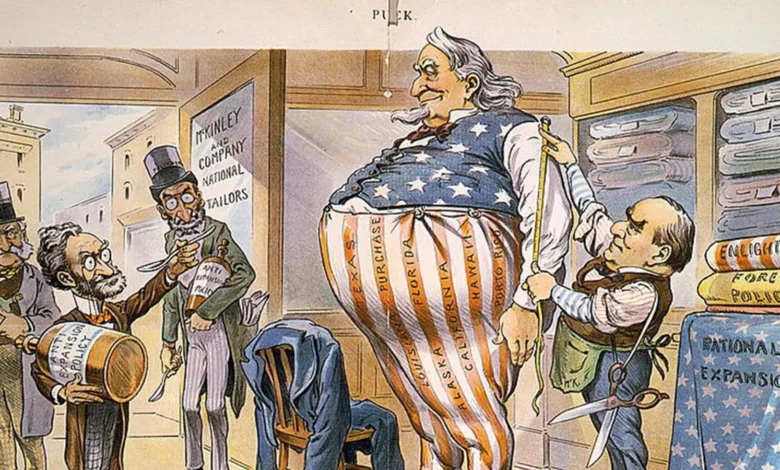
To be sure, the United States hardly sat on its hands until World War II. As it sought dominance in the Western hemisphere, the young nation steadily expanded westward, shunting aside Native Americans and launching a war in 1846 that led to the annexation of roughly half of Mexico’s territory. But when American policymakers strayed further afield, they faced sharp backlash at home.
Victory in the Spanish-American War of 1898 saddled the United States with Spain’s former possessions in the Caribbean and Pacific. Especially after thousands of U.S. soldiers died fighting insurgents in the Philippines, this bout of imperialism did not go over well with the electorate. “We assert that no nation can long endure half republic and half empire,” charged Democratic presidential nominee William Jennings Bryan in 1900.
Americans similarly soured on President Woodrow Wilson’s decision to enter World War I to “make the world safe for democracy.” The 1920 election was effectively a referendum on Wilsonian internationalism. The Republican nominee, Warren Harding, campaigned “against the internationalism” of Wilson and “for the policies of [George] Washington.” Harding won in a landslide, sparking America’s sharp strategic retreat during the interwar years. This isolationist impulse held strong even as Nazi Germany and Imperial Japan embarked down a path of aggression and territorial expansion.
This first era of U.S. grand strategy came to a decisive end on December 7, 1941, when Japan bombed Pearl Harbor. “That day ended isolationism for any realist,” wrote Senator Arthur Vandenberg of Michigan, who had until then been a leading proponent of isolation and non-intervention. President Roosevelt began what would result in a sea-change in U.S. grand strategy, forging a new bipartisan compact behind liberal internationalism.
Helping drive this foreign policy revolution were tectonic shifts in geopolitics. Advances in aviation and other military technologies led American policymakers to conclude that two great oceans no longer provided strategic shields. “The world has grown so small and weapons of attack so swift,” Roosevelt explained, “that no nation can be safe in its will to peace.” A new strategic principle would come to guide U.S. statecraft: “never again,” as described by historian Melvyn Leffler, “could the United States permit an adversary or coalition of adversaries to gain control of the preponderant resources of Europe and Asia.” To ensure safety at home, the United States had to venture abroad, defeat autocratic aggressors, and spread republican ideals.
Amid the onset of the Cold War, the United States left behind hemispheric isolation and became a crusader state. In the service of defending its worldwide interests and spreading democracy, the United States deployed its armed forces abroad in war and peace and constructed a web of defense alliances and a vast network of overseas bases. Between 1948 and the end of the Cold War, U.S. forces engaged in more than 40 military interventions.
Unilateralism gave way to multilateralism. The Senate approved membership in the United Nations by a vote of 89-2, and the Bretton Woods institutions were set up to oversee the international economy. Fervor for free trade displaced protectionism, and Washington took the lead in negotiating the liberalization of international commerce. The country also embraced a new sense of multiculturalism, bolstered by looser immigration laws and the victories of the civil rights movement.
The bipartisan compact behind liberal internationalism served as the political foundation for Pax Americana well into the twenty-first century. Western hegemony, underpinned by U.S. power, acquired a taken-for-granted quality.
Yet history is moving forward. America’s internationalist consensus has shattered. Decades of war in the Middle East have soured the electorate on military interventions and undermined trust in the political establishment. Automation, globalization, and deindustrialization have hollowed out the middle class and turned free trade into a dirty word on both sides of the aisle. The failure of international institutions to deliver has sapped enthusiasm for multilateralism, while a dysfunctional immigration system has eaten away at the fabric of multiculturalism. On foreign as well as domestic policy, Americans are deeply divided along ideological and partisan lines.
Trump is a symptom, not the cause, of the country’s political fracture and its turn against the establishment. And at least in theory, Trump’s pivot to America First represents an overdue course correction. Trump vowed to pull the nation back from decades of strategic overreach, ease off democracy promotion and multilateralism, and erect protectionist barriers that would revive the nation’s manufacturing sector. He also vowed to fix an immigration system that many Americans recognized as badly broken.
But Trump has overcorrected and underperformed. Rather than pulling off a needed strategic retrenchment, he attacked Iran, launching yet another failed war of choice in the Middle East and straining the nation’s alliances. Trump is right to back off promoting democracy abroad, but he corroded American democracy by disregarding the rule of law at home. In the meantime, his protectionism has worsened the nation’s affordability crisis and his harsh deportations have turned a majority of the U.S. public against his immigration policy.
Trump is doing an excellent job of bringing down the old order. But he shows no sign of putting in place a viable alternative.
Today, America is adrift; neither liberal internationalism nor Trump’s America First strategy is able to sustain domestic support. Wide swings in U.S. strategy are contributing to global instability and undermining U.S. leverage. With American history as our guide, it is time to create a new consensus — one that builds on the wisdom of both George Washington and Franklin Roosevelt and sets the country on a stable path forward.
The last major shift in U.S. foreign policy was forged in response to the catastrophe of World War II. This time, Washington must not wait for another great-power war to help birth an ordering moment. The clock is ticking. As China reaches great-power status and middle powers continue to rise, global power is diffusing from west to east and north to south; geopolitical rivalries are mounting in step. Yet with America’s purposes abroad no longer in equilibrium with its domestic means, the United States is not currently up to the task of providing steady leadership.
To get back on course and help anchor a changing world, America should now embrace what one might call “multilateralism-lite.” International cooperation remains necessary for solving global problems like trade, global warming, and AI regulation, but the United States cannot rely on bureaucratic and slow-moving institutions like the U.N. to address these problems.
Instead, it should focus on coalitions of the willing and bespoke groupings targeting specific tasks. Alongside such ad hoc coalitions, the United States should also encourage states to lean first and foremost on regional organizations, such as the Association of Southeast Asian Nations and the African Union, which should shoulder more responsibility and deliver more public goods in their neighborhoods.
As global power diffuses, the United States must for now set aside efforts to spread republican ideals and instead work with other nations — democracies and autocracies alike — to fashion a pluralistic and ideologically diverse global order. Democracies will need to compete respectfully in the marketplace of ideas with countries that adhere to alternative forms of governance. Autocracies will likewise need to live comfortably alongside liberal democracies.
International cooperation will require respect for sovereignty and toleration of differences over values and governance. In this respect, the United States and China should do more to build a pragmatic and constructive relationship. Teamwork between the world’s two leading powers will help facilitate global governance and reduce the chances of a dangerous rupture.
The crusading ethos that has defined U.S. foreign policy for the last 80 years must be tamed; America’s role as global policeman has run its course. At the same time, hemispheric isolation is not an option in an interdependent world. The United States still needs to help prevent the domination of Eurasia by a hostile power, even as it retrenches from and avoids wars of choice in other parts of the world. Keeping alliances in Europe and Asia alive and well is a cheap investment in maintaining a stable balance of power. As Washington presses allies to shoulder more burdens, it should still maintain a robust U.S. force presence in both theaters. This is the pathway toward a stable equilibrium between chronic overreach and dangerous detachment.
Such a refashioning of U.S. foreign policy will not be easy. In order to make it stick, U.S. democracy will have to get back up on its feet. Domestic investments will be needed to promote growth, bring down inequality, and educate Americans for the jobs of the future. A tamed brand of globalization – one that entails a more level playing field with trade partners but avoids protectionist overkill – can help ensure that the benefits of international trade are more widely shared. Only if it gets its own house once more in order will the United States have the power and purpose to provide effective leadership abroad.
America’s founders imparted enduring wisdom when they cautioned against unwise entanglement abroad. But the world of the 21st century is not the world of the founding era; like it or not, Americans are entangled in an interdependent globe. The United States must now step back without stepping away; it must do less, but still do enough. Arriving at that middle ground will be the challenge of the post-Trump era.