Does the Pentagon even know who its boat strikes are killing?
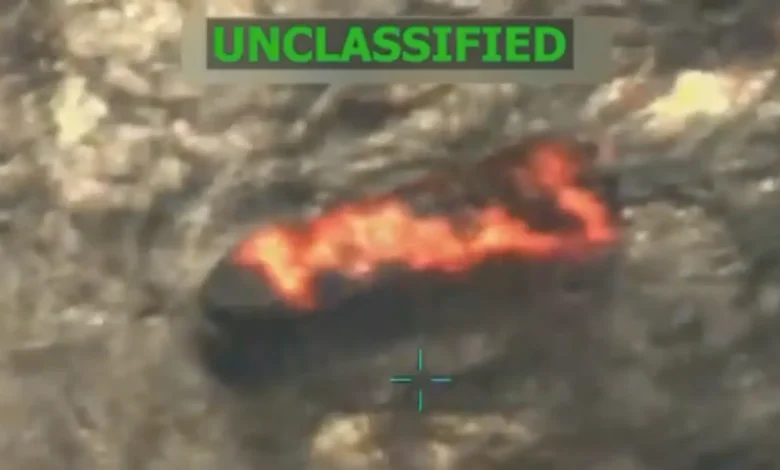
The Trump administration has killed at least 215 people in its 10-month campaign against alleged smugglers
Adam Isacson – Responsible Statecraft:
The numbers are stomach-turning. In less than 10 months, U.S. forces acting on orders from the Trump administration have killed 215 people in 63 aerial attacks on small boats in the Caribbean Sea and the eastern Pacific.
Since the first attack on September 2, the Trump administration has told us that they are killing drug traffickers. But drug trafficking, especially being a low-level courier, is not a crime punishable by the death penalty, and, even if it were, the U.S. legal system assumes innocence and guarantees a day in court. Skipping that step makes this murder under U.S. law: the equivalent of a cop shooting a fleeing suspect in the back.
The administration is attempting to get around this by claiming that every one of the dead is a “narco-terrorist,” a member or “affiliate” of a profit-seeking criminal group recently added, with no outside review, to a secret Defense Department list of “Designated Terror Organizations,” or DTOs. Because the United States is in a “non-international armed conflict” with the DTOs, a secret Justice Department memo argues, our military is permitted to kill them on sight, even with no self-defense justification.
Yet the administration has still not presented any evidence that a bombed vessel was even carrying drugs, much less that its deceased crew was affiliated with a criminal or “designated terrorist” organization.
What we know so far indicates that the U.S. military is being used to assassinate unknown individuals based on alarmingly flimsy evidence. And the targeting criteria are quite loose.
On the rare occasions when crew members have been recovered, “Military briefers have admitted to members of Congress that they cannot satisfy the evidentiary burden necessary to hold or prosecute survivors of the boat strikes,” reported the Intercept’s Nick Turse, who has covered the boat strikes extensively. Three survivors have been recovered alive; all have been let go without charges.
Questioning Secretary of State Marco Rubio at a hearing earlier this month, Sen. Tim Kaine (D-Va.) revealed that those carrying out boat-strike targeting are using three criteria that Kaine was not authorized to disclose publicly. He could disclose, however, that “evidence of narcotics on the boat” was remarkably not one of the three criteria.
In fact, the U.S. military usually doesn’t even know the identities of the people on the boats. The Washington Post reported that the targeting instructions in the boat-strike campaign’s August 5 Defense Department Execute Order (EXORD) “do not require positive identification of any individual but rather ‘reasonable certainty’ that adult males are members of, or affiliated with,” a DTO.
A former U.S. official who had read the EXORD told the Post, “The campaign may be killing individuals who in some cases have a tenuous link to any organized drug-running operation.” That official added, “When you define ‘DTO’ and ‘affiliate’ so loosely and you’re attacking boats, (the guidelines are) basically meaningless.”
The term “affiliate,” which the Trump administration is using to end lives on the open ocean, is especially squishy. Rep. Adam Smith (D-Wash.), the ranking Democrat on the House Armed Services Committee, told the New Republic’s Greg Sargent that, in a briefing with Pentagon officials, “They did not in any way, shape, manner, or form explain what the ceiling and floor are for ‘affiliated.’” People who received a classified briefing interviewed by the Intercept “said that they were under the impression that little more than a conversation with a DTO member might confer ‘affiliate’ status.”
“Some people who are familiar with boat movements” along the Caribbean coast of Colombia and Venezuela told the Latin American Center for Investigative Journalism that “it is common for the same boats that carry drugs on the outward journey to bring passengers back. The capitanes, as the boat operators are known, take whatever work they can get.”
The Intercept raised the possibility, acknowledged by a senior military officer, that some of those killed in the first strike on September 2 may have been migrants or human trafficking victims. That boat had 11 people aboard, a strangely large number for a short-hop drug delivery of less than 100 miles between Venezuela and Trinidad.
Evidence points to some of those killed in boat strikes being fishermen plying their trade. While residents of poor coastal fishing communities may “take occasional trafficking jobs to get by,” which blurs their identities, the likelihood of dying in a strike is scaring people away from getting in boats simply to fish, the New York Times reported from coastal Colombia and Ecuador. “Residents described entire communities abandoning fishing because the small ‘lanchas,’ or speedboats, used by traffickers and fishers are often indistinguishable.”
In Santa Marta, Colombia, the family of fisherman Alejandro Carranza, killed in a September 15 strike, insists that he was not involved in the drug trade. “If he was some kind of narcoterrorist,” the mother of three of Mr. Carranza’s children asked New York Times reporters, “then why are we living in misery instead of a mansion?”
Two of those killed in an October 14, 2025 strike were Chad Joseph, 26, and Rishi Samaroo, 41, both from the village of Las Cuevas, Trinidad. Their families are suing the United States for damages under the Death on the High Seas Act and the Alien Tort Statute. The complaint in Burnley v. United States argues that both men had been in Venezuela for months working on farms and, in their final communications, told their families that they had obtained passage by boat home to Trinidad.
In Sucre, Venezuela, where 90% of the population lacks basic food security, some of the dead were fishermen or taxi drivers who agreed to crew a boat that shipped drugs to Trinidad in exchange for a few hundred dollars. Some, like a “beloved” indoor soccer player, may simply have been aboard for the ride.
To all the concerns about the quality and reliability of intelligence used to target people for lethal boat strikes, we must add recent cases elsewhere pointing to U.S. reliance on faulty intelligence, or even just hunches. In March 2025, the Department of Homeland Security rendered 252 Venezuelan migrants to El Salvador’s feared Terrorism Confinement Center (CECOT) prison, alleging that they were all “terrorist” group members, an assertion that proved shockingly wrong, according to subsequent investigations. The New York Times revealed that an early March raid on an alleged DTO encampment in northern Ecuador, planned jointly by U.S. and Ecuadorian forces, in fact targeted a dairy farm. A March bombing in Iran that killed students at a school for girls is a well-known recent example elsewhere.
If even a few of the boat-strike victims are just fishermen, passengers, or low-level couriers with no relationship to big criminal syndicates, the Trump administration’s justification for the strikes simply cannot be sustained. It would confirm that this justification rests on a very rickety foundation of questionable intelligence, which should expose many in the chain of command to national and international criminal or civil liability.
The boat strikes need to stop immediately, and its architects and willing implementers must be investigated and held accountable at the earliest opportunity.