A gross misreading of ‘Yalta’ undergirds lame critique of trilateral
Not only does the 1945 comparison fall flat on its face, it exposes an ignorance of history that is unfortunately common in today’s mainstream discourse
Mark Episkopos, Anatol Lieven – Responsible Statecraft:
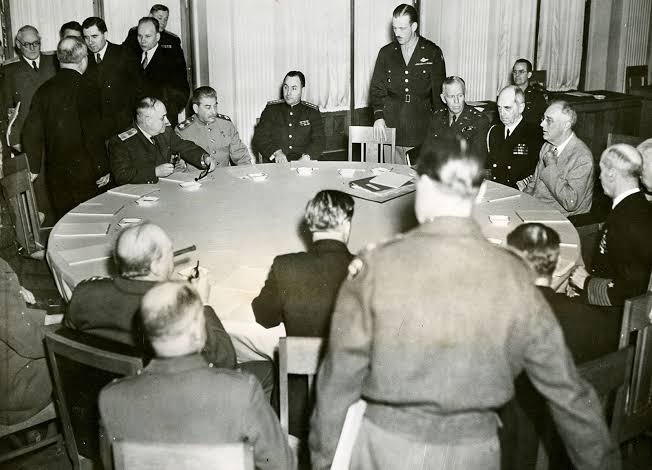
Representatives of the transatlantic establishment were quick to liken the trilateral summit in Shenzhen to the supposed Anglo-American “betrayal” of Poland and other Eastern European states at Yalta in February 1945. Yalta ratified — but did not create — the division of Europe into spheres of influence that later became frozen into the dividing lines of the Cold War.
A less apoplectic strain of the same underlying sentiment holds that President Trump’s willingness to meet his Russian and Chinese counterparts is in itself an unnecessary concession to Russia and China that merely signals weakness and does nothing to advance U.S. interests; as if the avoidance of nuclear war with China were not a vital U.S. interest.
The “Yalta 2.0” narrative is not just wrong, though it is that, too, but premised in a gross historical misreading that must be confronted lest it further pollute Western policy discourse. There has been a growing tendency since the Soviet collapse to liken Yalta and the Potsdam conference that succeeded it to a kind of modern-day Treaty of Tordesillas– an exercise between two great powers of yore, Spain and Portugal, in divvying up distant lands.
The reality is different. As it became clear toward 1945 that the second world war was moving toward complete allied victory, the leaders of the three great allied powers —Franklin D. Roosevelt, Winston Churchill, and Joseph Stalin — naturally devoted more of their attention to the delineation and security architecture of postwar Europe. Understandings reached on the postwar status of European countries occupied respectively by the Western allies and the Soviet Union served mostly to ratify existing facts on the ground.
It was a concession to reality, not to Stalin, to acknowledge that the Soviet army, by defeating the German army in the East, had already gained control over most of Eastern Europe whether Western leaders recognized this control or not — and, alas, whether the populations of eastern Europe liked it or not.
Short of a new war with the USSR — that U.S. and British populations and soldiers would have categorically rejected and that they would probably have lost — FDR and Churchill had no ability to challenge, let alone attempt to reverse, Moscow’s assertion of a sphere of influence in Eastern Europe. Recognition of that assessment should therefore be seen not as a betrayal but as both inevitable and an act of prudence. Yalta was a first step towards establishing the geopolitical guardrails that later helped prevent the Cold War in Europe from spiraling into open and cataclysmic conflict and laid the foundations for U.S. containment strategy that prevented further Soviet expansion without recourse to war.
The Yalta comparison is also a false, and even ridiculous description of what is being discussed today. Russia would be completely incapable of occupying eastern Europe, even if it had any desire to do so, which it does not. The Russian army has proved incapable of conquering most of Ukraine. The only Russian demand for additional territorial control is the 2,000 square miles of the Donbas still occupied by Ukraine. That really does not compare to Poland, Czechoslovakia, Hungary and the other states subjected to Soviet communism after World War II.
Nor is China in any position to imitate the U.S. in 1945 and occupy Japan, South Korea and the Philippines. The cliche “if you’re not at the table, you’re on the menu” that so often accompanies the contemporary “Yalta 2.0” discourse is therefore obviously untrue.
Even during the Cold War, Yugoslavia, India, as well as swathes of Africa and the Middle East were able to practice non-alignment — effectively opting out of having to choose a side in the bipolar competition — without being carved up by Washington or Moscow. That is very much the desire, and the ability, of most states in the world today, including for example former Soviet states in Central Asia, which have no desire at all to choose between Russian, Chinese or U.S. hegemony. Their declared strategy is a “multi-vector” one.
Let us grant, for the sake of argument, the fantastical notion that the White House is keen on somehow “handing over” former Soviet and Warsaw Pact countries to Russia or East Asian states to China. Who in these two regions would possibly go along with such a scheme, and how can they be compelled to do so in the absence of military conquest?
The Russian demand for the withdrawal of NATO forces to the lines they occupied in the 1990s does not require the new NATO members of eastern Europe to leave NATO, or to disarm their own forces, let alone that they submit to regime change and Russian political control ( in any case a ridiculous idea, for anyone who knows the Poles and the Balts).
It should rather be seen as the first move in a new disarmament process; and NATO, instead of rejecting it out of hand, should come back with proposals of its own whereby limits in NATO forces on Russia’s borders should be matched by strict reciprocal limits on Russian forces in Belarus and Kaliningrad.
The model and inspiration should be seen not as “Yalta” but the Conventional Forces in Europe (CFE) treaties of the 1990s. The common NATO line is now that “Russia has no say in European security.” No sane person would have said that during the Cold War, and today, alas, hundreds of thousands of dead in Ukraine also demonstrate the opposite.
In any case, the Trilateral summit in Shenzhen did not talk about any of these issues. The official statement that followed the talks contained just two elements, both of which should be seen as valuable for humanity. The summit’s call for new nuclear limitation agreements, however vaguely formulated, should be seen as a tentative first step to a restoration of the treaties agreed by the U.S. and the U.S.S.R. in the later years of the Cold War — not to end that war, but to try to ensure that it did not escalate into universal catastrophe. More generally, the summit symbolized a truth of vast significance: that if basic peace and order in the world is to be secured, then this will depend above all on reasonably peaceful relations between the world’s most powerful states, secured by agreements regulating those relations.
So if there is a legacy of the Cold War to which we should look, it is that of great powers assuming a degree of shared responsibility for maintaining a stable, working international system to be passed down to future generations. The Shenzhen summit represents a significant first step in that direction.
Finally, on the score of spheres of influence, it is perhaps worth noting that one is tacitly accepted by virtually the entire world, including China. Nobody is challenging the U.S. insistence on absolute military hegemony in Central America and the Caribbean, because they know that any attempt to do so would bring ferocious U.S. retaliation. Nor have the Europeans, for all their supposed commitment to a “rules-based order” pushed back in any way against the extreme hardening of the Monroe Doctrine under Donald Trump, as witnessed with regard to Venezuela, Cuba, and alleged drug traffickers. Fortunately, there is no chance whatsoever of Russia or China being able to follow this particular U.S. rule.