Gaby Hinsliff, The Guardian.
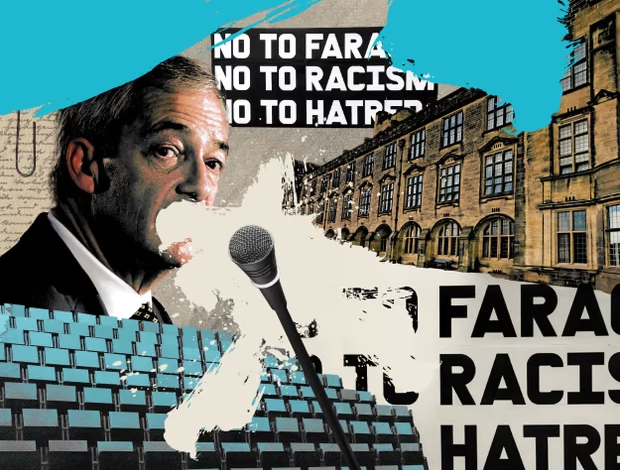
It must have seemed the easiest offer in the world to refuse. Would students at Bangor University enjoy a question-and-answer session with Sarah Pochin – the Reform UK MP famous for saying it “drives me mad” to see TV adverts full of black people – and Jack Anderton, the 25-year-old influencer who helped send Nigel Farage’s TikTok account viral among teenagers? No, the university’s debating society decided, it would not.
And had it filed the request in the bin, you wouldn’t be reading this. Until now, Anderton’s A New Dawn campus tour – a homage to the “debate me bro” style of the American rightwing activist Charlie Kirk, killed last year, who was famed for inviting liberal students to take on his arguments and live-streaming the results – hadn’t exactly set the heather alight. Reform is actively pushing to recruit inside universities, but in Cambridge, according to its student newspaper Varsity, only about 30 people turned up to hear Anderton argue that migrants are taking the part-time jobs students once used to do.
The same was true in Exeter and York, according to their respective student papers Exposé and York Vision. And despite noisy counter-protests, the tour wasn’t juicing the kind of controversy that commands attention on YouTube, where the really big crowds are. (The Cambridge event livestream had a paltry 177 views when I checked.)
So imagine how he must have felt when Bangor debating and politics society responded that “in line with our values” it was declining his offer, expressing “zero tolerance for any form of racism, transphobia or homophobia”.
Finally, a proper no-platforming! (Though strictly speaking, he and Pochin were never actually given a platform of which to be stripped.) That’s worth more in terms of reach than trekking to Bangor on a wet February night to face a half-empty room. GB News and the Daily Telegraph weighed in. Reform’s Zia Yusuf thundered on X that Bangor got £30m from taxpayers and he was “sure they won’t mind losing every penny of (their) state funding under a Reform government”. And that’s where it suddenly got serious.
Threatening to put universities out of business – with all that would mean for students halfway through their degrees, or towns reliant on a major employer – if they don’t fawningly accommodate any regime-backed political nonentity who asks is the stuff of autocracy, not democracy. And the lesson from Donald Trump’s America, where pro-free speech Republicans have proved remarkably intolerant of people speaking against them, is that the pressure rarely stops there.
What would stop the financial intimidation of a BBC reliant on the licence fee? What about charities and cultural or civic institutions receiving public grants, or newspapers with owners anxious to protect their other business interests, or schools? Though a Reform spokesperson later insisted Yusuf’s comments were “not party policy”, his literal job title is head of policy, and Reform has previously advocated removing at least some funding from universities that don’t protect free speech.
Vice-chancellors have been criticised for quietly seeking meetings with Reform. But I’m not surprised they’re anxious to lobby a prospective prime minister who publicly accuses them of poisoning young people’s minds, and who they are told sees Trump’s crusade against “woke” Ivy League universities as a model.
Academia is an obvious target for the populist right because it’s a classic wellspring of resistance: students are often first to the barricades and graduates are more likely to hold socially liberal views than people who left school at 18. But the financial crisis in England’s higher education system makes it unusually vulnerable to attack.
Some smaller institutions have already been brought to the financial brink by government curbs on foreign students, who pay higher fees than British students and have for years helped universities balance the books. If a Reform government pursuing close to zero immigration cuts student visas, it wouldn’t take much to tip some over the edge. (Ironically, among those most at risk might be smaller post-1992 institutions, some perhaps in Reform’s new heartlands.) Others would be in no position financially to resist political pressure. When Trump froze millions of dollars of research funding to universities that had rebuffed his demands over admissions and hiring policy, the teaching of conservative ideas and policing of campus protests, only the richest institutions could afford to fight back through the courts. And while UK law offers some protection for universities’ autonomy in research and teaching, laws can always be repealed.
That priceless academic freedom to think and explore what you like is, of course, a two-way street. Students must be willing to hear views they don’t like and learn how to argue back, a skill that matters more than ever now and is more safely acquired arguing face-to-face on campus than on social media.
But the current crop of students is perhaps sturdier than popular myth would have you think. Recent research at the Higher Education Policy Institute (Hepi) found 69% of students felt universities should never limit free speech, up from 60% in 2016. (Though admittedly Hepi also found a third favoured banning Reform speakers from campus and another 16% wanted Labour speakers banned, students showed a confusing tendency to advocate banning parties they had actually voted for. Have some just had enough of hearing from politicians?) After years of Conservative measures to promote free speech on campus, almost half of universities surveyed by the umbrella body Universities UK thought students did now understand better what that meant. What the Bangor affair underlines, however, is that the right to free speech isn’t the same as the right to a free audience whenever you happen to be campaigning in the neighbourhood; and that whatever you have to say, you can’t actively make people want to listen.
Anderton’s tour has now successfully visited five universities and is due in Edinburgh – where a previous event was cancelled by the venue – this evening. But crucially in each of these universities he was invited in, often by interested rightwing student societies. In Bangor, by contrast, he asked for a slot but got no takers.
Whatever you think of his Maga ideology, Kirk undeniably turned nerdy political debate into a kind of compelling gladiatorial spectator sport that spawned viral imitators on both sides of the political aisle, perhaps even helping confound the myth that young people can’t manage intellectual confrontation. What Anderton – whose value to Reform is his ability to jump on to gen-Z trends faster than cautious mainstream parties do – may be learning is that that isn’t as easy as Kirk made it look.
In this country, it turns out politicians still have to actually earn a hearing, not compel one. Well, that’s freedom for you.