Further US intervention in Haiti would be worst Trump move of all
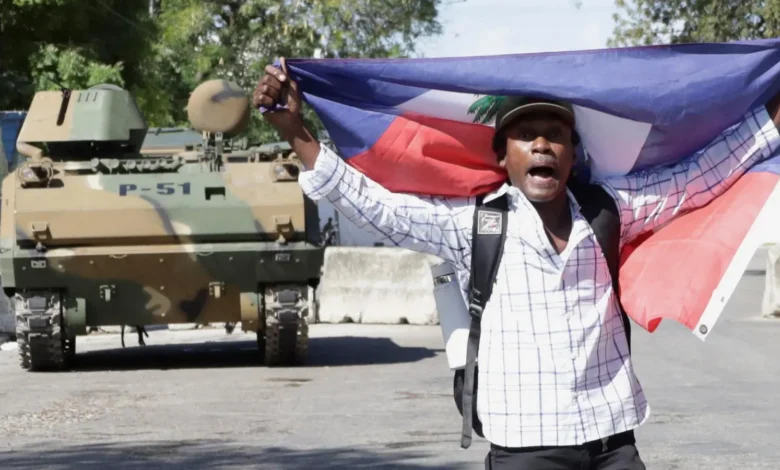
Washington sent warships this month to deploy ‘gunboat diplomacy’ while the island nation continues its freefall of violence and corruption
Leah Schroeder – Responsible Statecraft:
Early last week, U.S. warships and Coast Guard boats arrived off the coast of Port-au-Prince, as confirmed by the American Embassy in Haiti. On land in the nation’s capital, tensions were building as the mandate of Haiti’s Transitional Presidential Council neared expiration.
The mandate expired Feb. 7, leaving U.S.-backed Prime Minister Alix Didier Fils-Aimé in power. Experts believe the warships were a show of force from Washington to demonstrate that the U.S. was willing to impose its influence, encouraging the council to step down. It did.
This is far from the first time in history that the U.S. has asserted control over Haiti’s politics, but as the country remains wracked by gang violence, corruption, and poverty, many are left wondering how effective this latest U.S. intervention really has been.
An estimated 90% of Haiti’s capital is said to be controlled by gangs and, in 2025 alone, the United Nations estimates nearly 6,000 people have been killed and thousands injured amid rampant kidnappings and attacks — not to mention nearly half of the population is currently facing acute hunger. And with the fate of future elections still hanging in the balance, an air of uncertainty continues to hang over the troubled nation.
The Transitional Presidential Council, which Washington played a role in installing in April 2024, was intended to be a temporary entity to exercise presidential powers until either a new president was elected or the mandate expired. The council was created following a string of unprecedented political events following the assassination of Haitian President Jovenel Moïse in 2021, leaving a power vacuum.
With no functioning parliament, two men claimed power in Haiti, creating widespread confusion. One of the men, Ariel Henry, eventually took over, ruling without elected institutions amid worsening gang violence and weakening state authority. It was then that the U.S. and other international institutions stepped in to create the Transitional Presidential Council, which served as the head of state until very recently.
The presidential council stepped down last weekend after intense political pressure from the United States, just days after U.S. ships arrived in the Bay of Port-au-Prince. This comes after the council’s vote to oust the prime minister was met with decisive pushback from the U.S., which views Fils-Aimé as a stabilizing force against gang violence and a potential ally.
And though widespread gang violence prevented Haiti from holding a presidential election Feb. 7 as envisioned at the start of the mandate, Washington-backed Fils-Aimé is now expected to remain in power as the country readies itself to hold general elections — for the first time in more than a decade.
A statement from the U.S. Embassy on X said the presence of American warships off the coast in recent days “reflects the United States’ unwavering commitment to the security, stability, and a brighter future for the Republic of Haiti” and that it is intended to reaffirm “partnership and support” and “ensure a safer and more prosperous Haiti.”
But experts who spoke with RS say the presence of the ships sent a stronger message that could be interpreted as a show of support for Fils-Aimé to retain power and a threat if he did not. The ships were a “show of force,” according to Robert Fatton, a political science professor at the University of Virginia and author of several books on Haiti.
Some experts, including Christopher Fettweis, a professor of political science at Tulane University, compared this to the era of British gunboat diplomacy. Fettweis believes the ships were intended to give a “psychological impetus to the transition.”
It’s a “message that [the U.S. is] paying attention and are willing to throw their weight around when they want to,” Director of International Research at CEPR Jake Johnston said.
“This isn’t the U.S. saying, ‘We recognize what you decided,’” Johnston added. “This is the U.S. saying, ‘This is what you should decide, and it’s all we will recognize.’ The U.S. was always going to have influence. The question is how willing it is to exert that influence to produce a specific outcome. With this, the U.S. government is making clear that it is very willing to do so.”
There is nothing new about the U.S. intervening in Haitian politics or even using U.S. warships to project power over Haitian politics, according to the Executive Director of the Institute for Justice & Democracy in Haiti Brian Concannon. In fact, the U.S. was a key force behind the United Nations Security Council’s Gang Suppression Force efforts to police and reduce gangs in Haiti.
“For 200 years U.S. warships have been coming into the bay of Port-au-Prince to enforce U.S. decisions about who gets to run Haiti,” Concannon said. “Throughout Haiti’s history, U.S. warships have enforced U.S. dictates.”
After the recent U.S. invasion of Venezuela, Johnston said the U.S. threat of intervention in Haiti is more credible.
“This is happening in a context where the U.S. just militarily intervened in Venezuela and used military threats and force to push its political vision in the hemisphere,” Johnston said. “We don’t need to guess at the motivations.”
Though tentative election dates have been announced for August and December, many believe it to be unlikely that an election will be held at all this year. Despite recent efforts by a boosted UN police force and private security contractors to address the widespread presence of gangs, the violence has continued and could prove fatal for efforts to hold elections.
“I don’t necessarily think that American intervention will resolve the crisis,” Fatton said. “If anything, most interventions in the last 40 or 50 years have left a trail of souls. If Haitians are not in charge of what they are doing, I don’t think you’re going to transform Haiti.”